AI crawlers are the bots that AI companies send to read websites. Each one does one of three jobs. Training crawlers like GPTBot and ClaudeBot collect pages to train future AI models. Search crawlers like OAI-SearchBot and PerplexityBot build the index that AI search answers come from. User fetchers like ChatGPT-User open a page at the moment a person asks the AI about it.
Each bot has its own name in robots.txt, so you can block one job and allow the others. Most sites do exactly that. On November 11, 2026, we read 2,217 robots.txt files from sites that Google’s AI Overviews cite or that rank on Google’s first page. About 12 percent block GPTBot. Only about 4 percent block OAI-SearchBot, the bot that finds pages for ChatGPT search.
Below is the full list, with names and user agents taken from each company’s own docs. Then comes our data on who blocks what, and a robots.txt you can copy.
AI crawlers list (checked November 11, 2026)
The token is the name you write after User-agent: in robots.txt. The last column says what the company’s own page says about robots.txt.
| Token | Company | Job | Follows robots.txt? |
|---|---|---|---|
| GPTBot | OpenAI | Training | Yes |
| OAI-SearchBot | OpenAI | Search (ChatGPT search) | Yes |
| ChatGPT-User | OpenAI | User fetch | May not |
| OAI-AdsBot | OpenAI | Checks pages sent in as ChatGPT ads | Not stated |
| ClaudeBot | Anthropic | Training | Yes |
| Claude-SearchBot | Anthropic | Search | Yes |
| Claude-User | Anthropic | User fetch | Yes |
| Google-Extended | Gemini training and grounding (a token, not a bot) | Yes | |
| Googlebot | Google Search, including AI Overviews and AI Mode | Yes | |
| Google-Agent | AI agents that act for a user | Generally no | |
| PerplexityBot | Perplexity | Search | Yes |
| Perplexity-User | Perplexity | User fetch | Generally no |
| Applebot | Apple | Siri, Spotlight and Safari search | Yes |
| Applebot-Extended | Apple | Apple AI training (a token, not a bot) | Yes |
| Meta-ExternalAgent | Meta | Training and indexing | Yes |
| Meta-WebIndexer | Meta | Meta AI search | Yes |
| Meta-ExternalFetcher | Meta | User fetch | May not |
| CCBot | Common Crawl | Free public web archive | Yes |
| Bytespider | ByteDance | Not documented by ByteDance | Unknown |
| Amazonbot | Amazon | Amazon products, may train Amazon AI | Yes |
| Amzn-SearchBot | Amazon | Search in Alexa and other products | Yes |
| Amzn-User | Amazon | User fetch | Not always |
| DuckAssistBot | DuckDuckGo | AI answers in DuckDuckGo | Yes |
| MistralAI-Training | Mistral | Training | Yes |
| MistralAI-Index | Mistral | Search | Yes |
| MistralAI-User | Mistral | User fetch | Yes |
Bot names in robots.txt are not case sensitive, so gptbot and GPTBot work the same. A block takes time to apply. OpenAI, Perplexity and Meta say about 24 hours, and DuckDuckGo says 72 hours.
Training crawlers vs search crawlers vs user fetchers
The three jobs need different answers, so it helps to name them clearly. The diagram below sums them up.
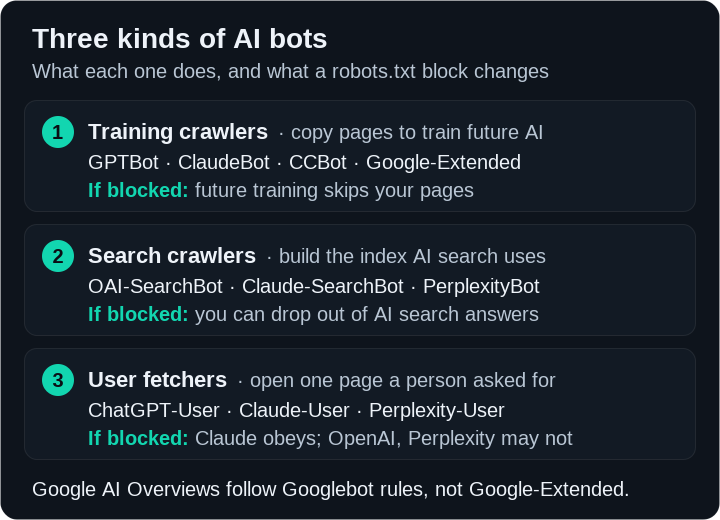
- A training crawler collects pages that may be used to teach future AI models. Blocking it changes what goes into later models. It does not change what a chatbot can find today.
- A search crawler builds the index an AI tool searches when it answers a question. Block it, and that tool can stop showing or citing your pages.
- A user fetcher opens one page because a person asked, for example by pasting a link into a chat. It acts like a browser for that person. That is why some companies say robots.txt may not apply to it.
Google and Apple work a little differently. They do not send a separate AI training bot. Their normal crawlers collect the pages, and a robots.txt token tells them what the content may be used for. The tokens are Google-Extended and Applebot-Extended.
What blocking each AI crawler does (and does not do)
| If you block | What it does | What it does not do |
|---|---|---|
| GPTBot | Tells OpenAI not to use your pages to train its models | Remove you from ChatGPT search |
| OAI-SearchBot | Keeps your pages out of ChatGPT search answers | Stop training. You can still show up as a plain link to your site. |
| ChatGPT-User | Asks ChatGPT not to open your pages for users | Work every time. OpenAI says robots.txt rules may not apply. |
| ClaudeBot | Tells Anthropic to leave your future pages out of training | Change Claude’s search, which uses Claude-SearchBot |
| Claude-SearchBot | Keeps your pages out of Claude’s search index | Stop training |
| Claude-User | Stops Claude from fetching your pages when users ask | Stop training |
| Google-Extended | Stops use in Gemini training and Gemini grounding | Remove you from Google Search, AI Overviews or AI Mode |
| Googlebot | Stops Google from crawling your pages, for Search and AI Overviews alike | Target AI features only |
| PerplexityBot | Keeps you out of Perplexity search results | Stop Perplexity-User, which generally ignores robots.txt |
| Applebot-Extended | Stops use in training Apple’s AI models | Remove you from Siri, Spotlight or Safari search |
| CCBot | Stops Common Crawl from adding new copies of your pages | Affect any search engine |
A robots.txt block asks bots to stay away from now on. It is not a request to delete what a company already collected.
Google’s AI features have their own controls. Google says robots.txt rules for Googlebot are the control for Search, and AI is part of Search. To limit what shows from your pages, it points to nosnippet, data-nosnippet, max-snippet and noindex. Google also added an opt-out setting in Search Console for its AI features, such as AI Overviews and AI Mode. Google says it rolled that out to all websites on August 31, 2026, and sites that opt out get no traffic from those features.
AI crawlers by company
OpenAI: GPTBot, OAI-SearchBot and ChatGPT-User
OpenAI runs three main bots, and its crawler page says each setting is independent. You can allow OAI-SearchBot to appear in ChatGPT search and block GPTBot to stay out of training. If you allow both, OpenAI says it may use one crawl for both jobs. A fourth bot, OAI-AdsBot, only visits pages that advertisers send in as ChatGPT ads.
These are the user agent strings OpenAI publishes. The version numbers can change.
GPTBot:        Mozilla/5.0 AppleWebKit/537.36 (KHTML, like Gecko); compatible; GPTBot/1.4; +https://openai.com/gptbot
OAI-SearchBot: Mozilla/5.0 (Macintosh; Intel Mac OS X 10_15_7) AppleWebKit/537.36 (KHTML, like Gecko) Chrome/131.0.0.0 Safari/537.36; compatible; OAI-SearchBot/1.4; +https://openai.com/searchbot
ChatGPT-User:  Mozilla/5.0 AppleWebKit/537.36 (KHTML, like Gecko); compatible; ChatGPT-User/1.0; +https://openai.com/bot
OAI-AdsBot:    Mozilla/5.0 AppleWebKit/537.36 (KHTML, like Gecko); compatible; OAI-AdsBot/1.0; +https://openai.com/adsbot
So the ChatGPT user agent you see in your logs, when someone asks ChatGPT about your page, is ChatGPT-User. OpenAI says this bot is not used to decide what appears in ChatGPT search.
Anthropic: ClaudeBot, Claude-SearchBot and Claude-User
Anthropic’s help page lists three bots. ClaudeBot collects pages for training. Claude-SearchBot improves Claude’s search results. Claude-User fetches pages when people ask Claude a question. Anthropic says its bots follow robots.txt, will not try to get past CAPTCHAs and support the Crawl-delay rule. It publishes the robots.txt names, not full user agent strings, and lists its IP addresses at claude.com/crawling/bots.json.
The older names anthropic-ai and Claude-Web are not on that page. Plenty of sites still block only those names, as our data below shows.
Google: Google-Extended, Googlebot and Google-Agent
Google has no separate AI training bot. Googlebot crawls the pages. The Google-Extended token then decides whether that content may train Gemini models and ground answers in Gemini Apps and Vertex AI. Google’s crawler page says Google-Extended “does not impact a site’s inclusion in Google Search nor is it used as a ranking signal.”
Google-Agent is newer. Google says agents running on its servers use it to browse the web and act for a user. It belongs to the user-triggered fetchers, which Google says generally ignore robots.txt rules.
Google-Agent (desktop): Mozilla/5.0 (X11; Linux x86_64) AppleWebKit/537.36 (KHTML, like Gecko; compatible; Google-Agent; +https://developers.google.com/crawling/docs/crawlers-fetchers/google-agent) Chrome/W.X.Y.Z Safari/537.36Perplexity: PerplexityBot and Perplexity-User
Perplexity says PerplexityBot finds and links websites in Perplexity search and is not used to train AI models. Perplexity-User visits a page when a user asks a question. Because a user asked for it, Perplexity says this fetcher “generally ignores robots.txt rules.”
PerplexityBot:   Mozilla/5.0 (compatible; PerplexityBot/1.0; +https://perplexity.ai/perplexitybot)
Perplexity-User: Mozilla/5.0 (compatible; Perplexity-User/1.0; +https://perplexity.ai/perplexity-user)
Apple: Applebot and Applebot-Extended
Applebot crawls for Siri, Spotlight and Safari. Apple says the same data may help train its AI models, and you opt out of that by disallowing Applebot-Extended. Your pages stay in Apple’s search either way. To keep a page out of AI answers in Siri and Search, Apple points to the nosnippet meta tag. One quirk: if your robots.txt never names Applebot but does name Googlebot, Applebot follows the Googlebot rules.
Meta: Meta-ExternalAgent, Meta-WebIndexer and Meta-ExternalFetcher
Meta’s crawler page lists three AI-related bots. Meta-ExternalAgent crawls for uses like training AI models. Meta-WebIndexer improves Meta AI search results. Meta-ExternalFetcher opens links at a user’s request, and Meta says it “may bypass robots.txt rules.” Their user agents start with meta-externalagent/1.1, meta-webindexer/1.1 and meta-externalfetcher/1.1. The older facebookexternalhit bot builds link previews.
Common Crawl: CCBot
CCBot builds Common Crawl, a free archive of more than 300 billion web pages that anyone can download. Researchers use it to build AI language models. Common Crawl says CCBot identifies itself as CCBot/2.0 (https://commoncrawl.org/faq/) and checks robots.txt before it crawls. Blocking it keeps your new pages out of that public archive.
ByteDance: Bytespider
Bytespider is widely reported to belong to ByteDance, the company behind TikTok. We could not find a crawler page from ByteDance that says what it collects or whether it follows robots.txt. So treat any claim about it with care. One detail from our data stands out: tiktok.com’s own robots.txt blocks Bytespider.
Amazon, Microsoft, DuckDuckGo and Mistral
- Amazon runs three bots. Amazon says Amazonbot improves its products and “may be used to train Amazon AI models.” Amzn-SearchBot feeds search in products like Alexa and is not used for AI training. Amzn-User fetches live pages for users and may not follow every robots.txt rule.
- Microsoft crawls with Bingbot. On October 30, 2026, it announced separate AI training and AI grounding settings for content used in Bing, Copilot and Microsoft 365. They take effect on February 1, 2027.
- DuckDuckGo runs DuckAssistBot for its AI answers. It says the data is not used to train AI models, and that blocking it does not affect your normal rankings.
- Mistral splits its bots by job: MistralAI-Training for training, MistralAI-Index for its search, and MistralAI-User for questions people ask in its Vibe app.
Who blocks AI crawlers? We checked 2,721 robots.txt files
We fetched robots.txt files on November 11, 2026, from two groups of websites:
- Sites AI cites: all 1,394 websites that Google’s AI Overviews cited in our October 2026 AI Overviews study.
- Sites Google ranks: the 1,906 websites in the organic results on page one for the same 494 searches, pulled fresh on November 11.
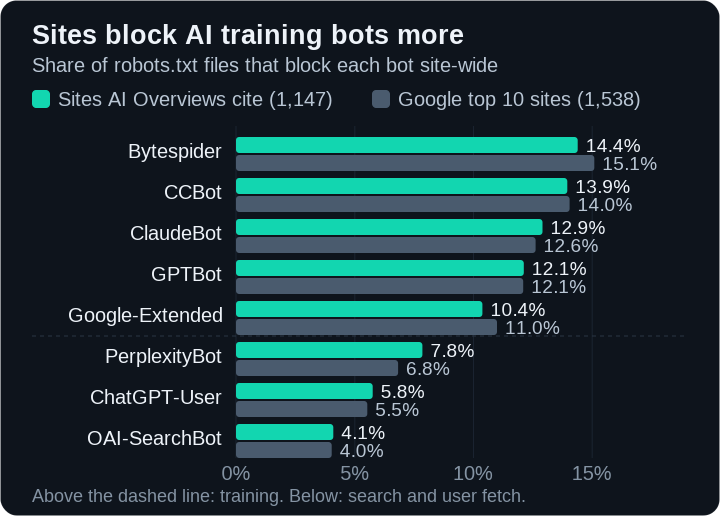
579 sites are in both groups, so we fetched 2,721 different files. We could read 2,217 of the 2,721 files. The rest refused our clearly labeled research client or failed to load, and we explain that below. The chart shows the share of readable files whose rules block each bot from the whole site.
| Bot | Job | Sites AI cites (1,147 files) | Google top 10 sites (1,538 files) |
|---|---|---|---|
| GPTBot | Training | 12.1% | 12.1% |
| ClaudeBot | Training | 12.9% | 12.6% |
| CCBot | Training | 13.9% | 14.0% |
| Bytespider | Training | 14.4% | 15.1% |
| Google-Extended | Training | 10.4% | 11.0% |
| Applebot-Extended | Training | 11.2% | 10.7% |
| Meta-ExternalAgent | Training | 11.9% | 11.6% |
| Amazonbot | Training | 10.5% | 10.5% |
| OAI-SearchBot | Search | 4.1% | 4.0% |
| Claude-SearchBot | Search | 4.3% | 4.4% |
| PerplexityBot | Search | 7.8% | 6.8% |
| DuckAssistBot | Search | 4.2% | 4.5% |
| ChatGPT-User | User fetch | 5.8% | 5.5% |
| Claude-User | User fetch | 4.5% | 4.5% |
| Perplexity-User | User fetch | 5.1% | 5.0% |
| Meta-ExternalFetcher | User fetch | 5.2% | 5.1% |
| anthropic-ai | Old Anthropic name | 11.0% | 10.9% |
| Claude-Web | Old Anthropic name | 10.2% | 9.5% |
| Googlebot | Search (Google) | 0.1% | 0.3% |
| Bingbot | Search (Bing) | 0.2% | 0.5% |
“Blocks the whole site” counts a site when its rules for that bot cover every page. That includes sites with Disallow: / under User-agent: * that never name the bot. Only 19 (1.7 percent) of the cited sites block every unnamed bot this way, so most blocks name the bot directly.
Sites block training bots about three times more than search bots
Among the cited sites, 12.1 percent block GPTBot, but only 4.1 percent block OAI-SearchBot. ClaudeBot shows the same gap: 12.9 percent against 4.3 percent for Claude-SearchBot. The top 10 sites show the same pattern: 12.1 percent block GPTBot and 4.0 percent block OAI-SearchBot.
So many publishers are fine with being found and cited by AI search. They object to being used as training data. PerplexityBot is the exception among search bots. It is blocked more than twice as often as OAI-SearchBot, at 7.8 percent of cited sites.
Bytespider and CCBot top the list, at 14.4 and 13.9 percent of cited sites. Almost no site blocks Googlebot. That matters because Googlebot is the crawler behind AI Overviews.
Blocking Google-Extended does not keep a site out of AI Overviews
Google-Extended is the most misunderstood token on this list. Many site owners add it to stay out of Google’s AI answers. Our data shows that it does not do that.
We took every cited site that blocks Google-Extended by name today and has at least two citations in our October study. Then we checked old copies of their robots.txt in the Internet Archive. 19 sites already blocked Google-Extended in a copy saved before our October 9 study ran. Those 19 sites were still cited 70 times across the 380 desktop AI Overviews in that study. 67 of the 380 AI Overviews cited at least one of them.
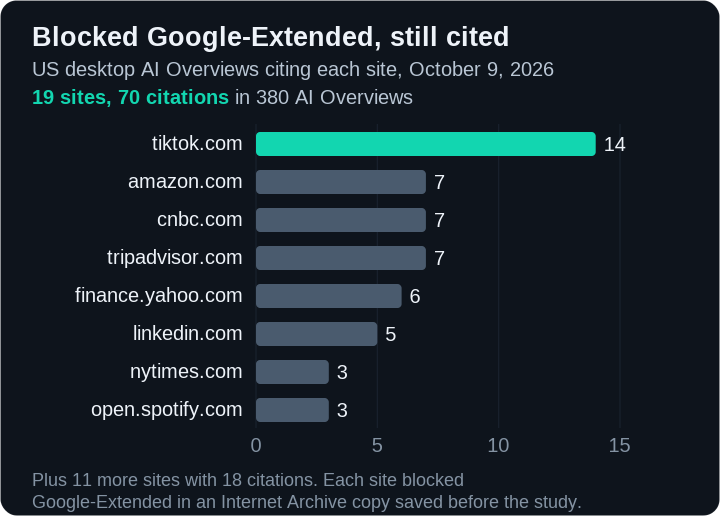
This matches what Google says: Google-Extended controls Gemini training and grounding, not Search. If you want out of AI Overviews, the controls are the Search Console setting and snippet rules like nosnippet.
We also found the opposite trap. facebook.com blocks Google-Extended today, but a copy saved on October 9 shows only a partial block. A robots.txt check made today cannot explain citations from last month without old copies.
Many sites still block old bot names
anthropic-ai and Claude-Web are not on Anthropic’s current crawler page. Yet 11.0 percent of cited sites block anthropic-ai, and 10.2 percent block Claude-Web. Most of them also block ClaudeBot. 7 sites fully block an old name but not ClaudeBot, including espn.com, commonapp.org and three Trustpilot sites. Those sites may think Claude is blocked when the current bot is not.
Copied block lists go stale. Check each name against the company’s own page before you paste it.
The new shared training rule is already in use
A shared robots.txt name for AI training, __usage_ai-training, was proposed on October 30, 2026. Twelve days later, 5 cited sites already use it: facebook.com, instagram.com, linkedin.com, imdb.com and wikihow.com. Among the top 10 sites, 6 use it. That adds x.com.
Cloudflare’s older format is more common. 48 of the readable cited files (4.2 percent) carry a Content-Signal line, and 37 of those say ai-train=no. 28 of them use the exact line from Cloudflare’s managed robots.txt: search=yes, ai-train=no, use=reference.
Almost 1 in 5 files would not load for us
Of the 2,721 robots.txt files we asked for, 504 (18.5 percent) would not load for us. Bot protection refused 362 of them, usually with a 403 Forbidden error. Another 98 failed on network errors or timeouts, 32 sent back a web page instead of a robots.txt file, and 12 had server errors. For the cited sites alone, 247 of 1,394 failed (17.7 percent).
We did not try to get past those blocks. Our client named itself as a research tool, and we did not pretend to be a browser. A failed fetch tells you nothing about what AI bots see. Sites can let known crawlers through and refuse everyone else.
How to block AI training bots but stay in AI search
This robots.txt blocks the main training crawlers and keeps AI search and user fetchers allowed. The comments say what each group does.
# AI search and user fetchers: allowed, so AI answers can find and cite you
User-agent: OAI-SearchBot
User-agent: ChatGPT-User
User-agent: Claude-SearchBot
User-agent: Claude-User
User-agent: PerplexityBot
User-agent: Perplexity-User
Allow: /

# AI training: blocked
User-agent: GPTBot
User-agent: ClaudeBot
User-agent: Google-Extended
User-agent: Applebot-Extended
User-agent: CCBot
User-agent: Meta-ExternalAgent
User-agent: Bytespider
User-agent: Amazonbot
User-agent: MistralAI-Training
Disallow: /

# The new shared AI training rule (a draft, read by some companies)
User-agent: __usage_ai-training
Disallow: /

# Everyone else, including Googlebot and Bingbot
User-agent: *
Allow: /
Follow these steps to add it:
- Open your current file. Go to
yoursite.com/robots.txtand copy what is there. - Watch for the group trap. Google’s rules say only one group applies to each crawler, the most specific one. Once you name a bot, it ignores your
User-agent: *rules. Copy anyDisallowlines you still want, like/cart/, into each named group. - Keep Googlebot allowed. Blocking it stops Google from crawling your pages for Search and AI Overviews.
- Add every subdomain. Each host has its own robots.txt. Anthropic and Amazon both say a file covers only its own host.
- Test and wait. Use the robots.txt report in Search Console for Google. Give other bots a day or more to pick up the change.
- Check your logs a week later. See the next sections for how.
If you would rather stay out of AI search too, add the search bots to the blocked group. Just know what it costs: OpenAI says sites that block OAI-SearchBot are not shown in ChatGPT search answers. Our LLM SEO guide explains how those answers pick their sources.
The new shared AI training rule: __usage_ai-training
On October 30, 2026, an Anthropic engineer published an IETF draft for one robots.txt name that covers AI training at every company that adopts it. It uses the normal robots.txt format:
User-agent: __usage_ai-training
Disallow: /
Allow: /press-kit/
This says “do not train on my site, except the press kit.” Under the draft, a file without this group states no preference at all. Three companies said where they stand that same day:
| Company | What it said on October 30, 2026 |
|---|---|
| Anthropic | Its help page says it began reading this “no AI training” signal that day, with a gradual rollout. A rule that names ClaudeBot still wins. |
| Plans to support it in early 2027. An opt-out will count as blocking Google-Extended, unless the file names Google-Extended. | |
| Microsoft | Will read AI training rules in robots.txt from February 1, 2027. |
OpenAI’s crawler page did not mention the new name when we checked on November 11, 2026. It is still a draft, so keep the company names like GPTBot in your file as well.
You may also see a Content-Signal line, such as Content-Signal: search=yes, ai-train=no. That is Cloudflare’s Content Signals Policy from September 2025. Cloudflare itself says these signals express preferences and are not technical blocks. None of the AI crawler pages we read mention it.
Can AI crawlers ignore robots.txt?
Yes. A robots.txt file is a public note that asks bots to behave. Nothing in it stops a bot that chooses not to read it. The big training and search crawlers say they follow it. User fetchers are the gap: OpenAI, Perplexity, Meta and Google all say theirs may skip robots.txt, because a person asked for the page.
Fake bots are the other problem. Anyone can put “GPTBot” in a user agent. To check a visitor, compare its IP address with the list the company publishes.
| Company | Published IP lists |
|---|---|
| OpenAI | openai.com/gptbot.json, /searchbot.json, /chatgpt-user.json, /adsbot.json |
| Anthropic | claude.com/crawling/bots.json |
| common-crawlers.json, special-crawlers.json, user-triggered-fetchers.json, user-triggered-fetchers-google.json, user-triggered-agents.json | |
| Perplexity | perplexity.ai/perplexitybot.json, /perplexity-user.json |
| Apple | search.developer.apple.com/applebot.json |
| Common Crawl | index.commoncrawl.org/ccbot.json |
| Amazon | Three lists on developer.amazon.com/amazonbot |
| DuckDuckGo | duckduckgo.com/duckassistbot.json |
| Mistral | mistral.ai/mistralai-index-ips.json, /mistralai-user-ips.json |
| Meta, ByteDance | None on the pages we read |
Google’s files sit under developers.google.com/static/crawling/ipranges/. If you must stop a bot for real, block it at your firewall or CDN. Anthropic warns that IP blocks can also stop its bots from reading your robots.txt, so it recommends robots.txt rules first.
How to see which AI bots visit your site
Your analytics will not show them. GA4 filters known bots, and most crawlers never run its tracking script. Our guide to bot traffic explains the gap. Look in your server logs instead:
grep -oE "GPTBot|OAI-SearchBot|ChatGPT-User|ClaudeBot|Claude-SearchBot|Claude-User|PerplexityBot|Perplexity-User|CCBot|Bytespider|meta-externalagent|Amazonbot|Google-Agent" access.log | sort | uniq -c | sort -rnThis counts requests per bot name. Then check a few IP addresses against the lists above, since some hits will be fakes.
Bot visits are only half the story. When an AI answer sends you a real visitor, that visit does show up in your analytics. Our referral traffic guide shows where to find ChatGPT and other AI tools in GA4. To see whether AI tools mention you at all, use a fixed prompt list, as in our guide to tracking AI visibility.
Want to point AI tools at your best pages? That is a different file. Your robots.txt decides who may read your site. An llms.txt file is an optional guide to your key pages, and it cannot block anything.
How we ran the robots.txt check
The two site groups. The cited group is every host in the aio_reference_domains column of our October 2026 dataset, desktop and mobile: 1,394 hosts. The top 10 group comes from the same 494 desktop searches, fetched again on November 11, 2026 through the DataForSEO SERP API (United States, English, desktop, first page). That gave 4,073 organic results from 1,906 websites. We read each site from the address Google shows, and from the site name for results like YouTube videos that show no address.
Fetching. For each host we requested https://host/robots.txt, then the www version, then plain http. We used curl with a 25 second timeout, followed up to five redirects, and ran a second round for failures. Every request named itself robots-txt-research/1.0. We did not use browser user agents or headless browsers to get past bot protection.
Reading the rules. We followed the robots.txt standard (RFC 9309) and Google’s reading of it. Names are matched without case. All groups that name a bot are merged, and the * group applies only when no group names the bot. The longest matching rule wins, and Allow wins a tie. Files are cut at 500 KiB, as Google does.
What counts as a block. A bot counts as blocked from the whole site when its rules disallow three test paths: the home page, a blog post and a product page. A missing file (404) counts as no rules, which is how Google treats it.
The Google-Extended check. We started with the 45 cited sites that block Google-Extended by name today and have two or more citations. For each, we looked up the last Internet Archive copy saved before 18:38 UTC on October 9, 2026. That was when the study’s searches ran. 19 copies showed a full block, 1 showed a partial block (Facebook), and 25 had no usable copy.
Limits.
- robots.txt shows what a site asks, not what bots do. We did not check whether any bot obeyed.
- Some sites may show different files to different visitors. reddit.com served us a file that blocks every bot. Yet it was the second most cited site in our AI Overviews study. What Google’s crawler sees there may differ from what we saw. We counted what we received.
- One day, US results. Both site groups come from US English searches.
- Failed files are left out of the shares. The most cited sites failed about as often as the rest: 15 of the 100 most cited, against 18 percent of all cited sites.
The SERP data cost $0.30 in DataForSEO API fees. Fetching robots.txt files costs nothing.
Download the data
Get the full results as a CSV file: ai-crawlers-list-2026-11.csv. It has one row per website.
| Column | What it holds |
|---|---|
| host | The website, as cited or ranked |
| in_aio_cited_set, aio_overviews_desktop | 1 if AI Overviews cited it in October, and how many desktop AI Overviews did |
| in_top10_set, top10_keywords | 1 if it ranked in the top 10 on November 11, and for how many of the 494 searches |
| fetch_status | ok, no_file, or why it failed |
| robots_url | The address that answered |
| content_signal | The Content-Signal line, if any |
| One column per bot | blocked, blocked_by_wildcard, partial, allowed_by_name or no_rule |
blocked_by_wildcard means the site never names the bot, but its User-agent: * rules block every page. If you use the data, please link back to this page.
You can run the same check on your own market. Pull the top 10 results for your keywords with a SERP API and collect the domains. Then fetch each robots.txt the way we describe above.
Frequently asked questions
What is GPTBot?
GPTBot is OpenAI's training crawler. It collects public pages that may be used to train OpenAI's AI models. Blocking it in robots.txt tells OpenAI not to use your pages for training. It does not remove you from ChatGPT search, which uses a different bot called OAI-SearchBot.
What is the ChatGPT user agent?
When ChatGPT opens a page because a user asked, it identifies as ChatGPT-User. OpenAI lists the full string as: Mozilla/5.0 AppleWebKit/537.36 (KHTML, like Gecko); compatible; ChatGPT-User/1.0; +https://openai.com/bot. ChatGPT search crawling uses OAI-SearchBot, and training uses GPTBot.
What is ClaudeBot?
ClaudeBot is Anthropic's training crawler. Anthropic says blocking it tells the company to leave your future pages out of its training data. Anthropic also runs Claude-SearchBot for search and Claude-User for pages that people ask Claude to read. Each one is blocked by its own name.
Does blocking Google-Extended remove my site from AI Overviews?
No. Google says Google-Extended does not affect inclusion in Google Search, and AI Overviews are part of Search. In our check, 19 sites that blocked Google-Extended before our October 2026 study were still cited in AI Overviews. Google's own control for that is a setting in Search Console, plus snippet rules like nosnippet.
Should I block AI crawlers?
Block the training crawlers if you do not want your pages used to train models. Keep the search crawlers allowed if you want to be cited in ChatGPT, Claude or Perplexity answers. Blocking everything removes you from AI search too, and it does not delete data a company already collected.
Do AI crawlers follow robots.txt?
OpenAI, Anthropic, Google, Perplexity, Apple and Common Crawl all say you control their training and search crawlers with robots.txt. User fetchers are different. OpenAI and Perplexity say theirs may ignore it because a person asked for the page. A robots.txt file is a request, not a lock, so use a firewall rule if you must stop a bot.
Sources and further reading
- OpenAI: Overview of OpenAI crawlers developers.openai.com
- Anthropic: Does Anthropic crawl data from the web, and how can site owners block the crawler? support.claude.com
- Google: Google's common crawlers, including Google-Extended (updated October 30, 2026) developers.google.com
- Google: User-triggered fetchers, including Google-Agent (updated August 19, 2026) developers.google.com
- Google Search Central: AI features and your website developers.google.com
- Google: New opportunities, control and insights for website owners (Search Console AI toggle, August 31, 2026) blog.google
- Google Search Central Blog: Supporting a shared AI training control in robots.txt (October 30, 2026) developers.google.com
- IETF draft: Machine-Readable Training Preference Signal (October 30, 2026) datatracker.ietf.org
- Microsoft Bing: Clearer preferences for training and grounding (October 30, 2026) blogs.bing.com
- Perplexity: Perplexity crawlers docs.perplexity.ai
- Apple: About Applebot (September 4, 2026) support.apple.com
- Meta: Meta web crawlers developers.facebook.com
- Common Crawl: CCBot commoncrawl.org
- Amazon: Amazonbot, Amzn-SearchBot and Amzn-User (updated October 26, 2026) developer.amazon.com
- DuckDuckGo: About DuckAssistBot duckduckgo.com
- Mistral: Mistral crawlers docs.mistral.ai
- Cloudflare: Content Signals Policy (September 24, 2025) blog.cloudflare.com
- Google Search Central: How Google interprets the robots.txt specification developers.google.com
- Cloudflare docs: Managed robots.txt and its Content-Signal line developers.cloudflare.com
- Common Crawl: home page (archive size) commoncrawl.org
- DataForSEO docs: Google Organic SERP task_post (standard queue) docs.dataforseo.com
- Internet Archive: Wayback Machine web.archive.org