DuckDuckGo has one official API: the free Instant Answer API at api.duckduckgo.com. It needs no key and no sign-up. But it does not return search results. It returns short instant answers, mostly a Wikipedia summary of a known topic, and nothing at all for most searches.
We tested it on November 11, 2026, with 301 real keywords. It answered 19 of them (6%), and none of the 43 question searches. For full web results, use the Brave Search API, a Google SERP API, or SerpApi’s DuckDuckGo engine. We compare all three below.
Does DuckDuckGo have a search API?
Not for full results. The DuckDuckGo Instant Answer API is a free endpoint that returns DuckDuckGo’s instant answers as JSON, such as a topic summary, related topics or a !bang redirect. It does not return the list of links you see on duckduckgo.com.
DuckDuckGo said so itself. The summary line of its old API page read: “An API for some of our Instant Answers, not for full search results”. The same page said DuckDuckGo does not have the rights to fully syndicate its results, free or paid.
The reason is where the links come from. DuckDuckGo’s help page on sources says it gets most of its traditional links and images from Bing. It also runs its own crawler, DuckDuckBot. Its instant answers come from sources such as Wikipedia.
Two more facts matter if you are following an old tutorial:
- The docs page is gone. The page at duckduckgo.com/api was online until September 2022, as archived copies show. Today that address just opens a DuckDuckGo search for the word “api”.
- The endpoint still works. All 326 requests in our test on November 11, 2026, came back with HTTP 200. So the API is alive, just undocumented.
What does the DuckDuckGo Instant Answer API return?
Every reply is one JSON object with the same core fields. For most searches, almost all of them are empty. The figure below shows a real reply for the query “DuckDuckGo”, cut down to the fields that matter.
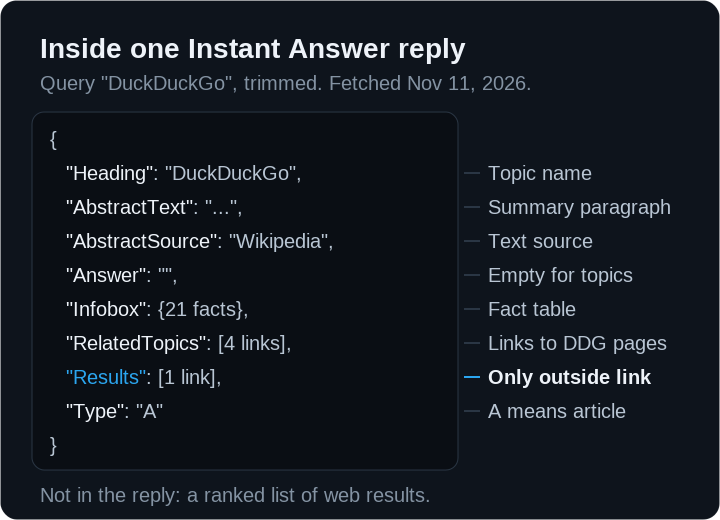
Here is what each field holds, and how often it had something in our test of 301 keywords:
| Field | What it holds | Filled in our test |
|---|---|---|
Heading | The topic name | 19 of 301 |
AbstractText | A short summary of the topic | 19 of 301 |
AbstractSource, AbstractURL | Where the summary comes from, with a link | Wikipedia, all 19 times |
Answer, AnswerType | A computed answer, such as a random password | 0 of 301 |
Definition | A dictionary definition | 0 of 301 |
Infobox | A table of facts about the topic | 7 of 301 |
RelatedTopics | Links to related topics, on duckduckgo.com | 18 of 301 |
Results | Outside links, such as the official site | 4 of 301 |
Type | A article, D disambiguation, C category, N name, E exclusive, or empty | A 19 times, empty 282 times |
Redirect | Where a !bang query sends you | Only for !bang queries |
The field names and type letters come from DuckDuckGo’s archived docs. The counts are ours.
Notice what is missing. There is no field for a ranked list of web pages. Results comes closest. In our test it never held more than 2 links, and every one was a brand’s official site.
One more trap: do not use the meta field to check for an answer. In our test, 281 of 282 empty replies still carried a meta block. It described a module named “Just Another Test”. Check AbstractText, Answer and Redirect instead.
How to call the DuckDuckGo API (no key needed)
You send a GET request with your query. There is no key, no account and no header to set.
curl -s "https://api.duckduckgo.com/?q=DuckDuckGo&format=json&no_html=1&t=myappname"In Python, with the requests library:
import requests

params = {
    "q": "DuckDuckGo",
    "format": "json",
    "no_html": 1,
    "t": "myappname",  # name your app, as DuckDuckGo asks
}
r = requests.get("https://api.duckduckgo.com/", params=params, timeout=10)
data = r.json()

if data["AbstractText"]:
    print(data["Heading"] + ": " + data["AbstractText"])
    print("Source:", data["AbstractSource"], data["AbstractURL"])
else:
    print("No instant answer for this query.")
These are the parameters DuckDuckGo documented:
| Parameter | What it does |
|---|---|
q | Your search query |
format | json or xml |
no_html | 1 removes HTML, such as bold and italics, from the text |
skip_disambig | 1 skips “which one did you mean?” replies (type D) |
no_redirect | 1 stops !bang queries from redirecting and returns the target URL instead |
t | The name of your app |
callback, pretty | A JSONP callback, and indented JSON |
Two quirks are worth knowing before you build on it. We checked both on November 11, 2026:
- Capital letters matter. “blackberry” returned a list of meanings, with the fruit first. “BlackBerry” returned a summary of the phone brand. DuckDuckGo’s old docs used the same example.
skip_disambigmakes a guess for you. Plain “python” returned a list of meanings, with the programming language first. Withskip_disambig=1, the API instead returned a summary of PYTHON, a British Cold War plan.
Rules for using the DuckDuckGo API
DuckDuckGo’s archived API page set three rules:
- Credit both sources. Say the result comes from DuckDuckGo, and link to the underlying source, such as the Wikipedia page.
- Get approval for commercial use. Non-commercial use is fine. For anything else, DuckDuckGo asked you to email them first.
- Name your app. Add a
tparameter, such as&t=myappname, to every request.
We found no newer version of these rules on DuckDuckGo’s site, so treat them as current. Its URL parameters page adds a related rule for apps and extensions: do not strip out DuckDuckGo’s branding or ads.
Does the DuckDuckGo API have a rate limit?
DuckDuckGo never published a number. Its old docs said it cannot support many requests per second from a single machine, and that automatic throttling applies. They said the API was made for your app’s front end, called once per user action. If you need more, DuckDuckGo asked you to get in touch.
In our test, we sent about 1 request every 2 seconds from one machine. All of them worked, and the median reply took 261 ms. We did not try to find the ceiling. That would be rude to a free service, and the number could change at any time.
We tested the DuckDuckGo API on 301 real keywords
We wanted to know how often the API has anything to say. So we took 301 keywords from our Google AI Overviews study, 43 from each of 7 query types. These are real US searches with known search volume. We also added 25 tool searches of our own, such as “5 times 7” and “weather new york”. The DuckDuckGo website answers searches like these in a box.
On November 11, 2026, we sent each keyword to the API with format=json, no_html=1 and no_redirect=1. We counted a keyword as answered if the reply had a summary, an answer, a definition or a redirect. The chart below shows the share answered for each query type.
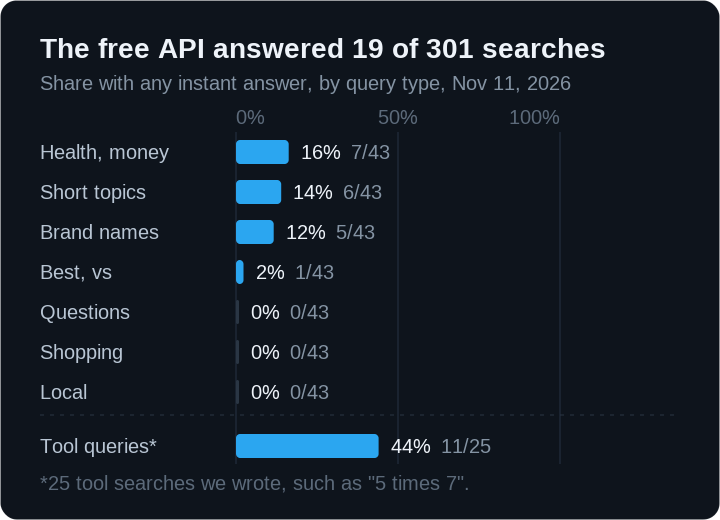
| Query type | Example keyword | Answered | Share |
|---|---|---|---|
| Health and money | signs of pregnancy | 7 of 43 | 16% |
| Short topics | hot chicken | 6 of 43 | 14% |
| Brand names | safeco insurance | 5 of 43 | 12% |
| Best and vs | mac vs pc | 1 of 43 | 2% |
| Questions | are eggs keto | 0 of 43 | 0% |
| Shopping | low cost flights | 0 of 43 | 0% |
| Local | dentist jacksonville fl | 0 of 43 | 0% |
| All 301 real keywords | 19 of 301 | 6% | |
| Tool searches we wrote | 5 times 7 | 11 of 25 | 44% |
What we found:
- Only searches that match a Wikipedia topic got answers. All 19 answers were Wikipedia summaries. Questions, shopping searches and local searches got nothing, 0 of 129.
- Many answers were about a wider topic. “signs of pregnancy” returned the summary for Pregnancy. “50 year mortgage” returned Mortgage loan. “mac vs pc” returned Get a Mac, an old Apple ad campaign.
- “mortgage calculator” returned an article, not a calculator. The summary explained what a mortgage calculator is.
- Brand names came with an official site. Four of the five brand answers, such as Safeco and Pizza Pizza, also listed the official site in
Results. No other keyword got an outside link. - Few answers had a fact table. 7 of the 19 had an
Infobox, and 13 had an image.
What about the instant answers on duckduckgo.com?
The website shows far more instant answers than the API returns. DuckDuckGo’s help page on instant answers gives five examples: “5 times 7”, “what rhymes with duck”, the Mighty Ducks cast, flight DL10 and a strong password. We sent all five to the API. Only the password one came back with an answer.
“5 times 7” was the oddest. The reply said its answer type was calc, but the answer itself was empty. Unit conversions such as “10 miles to km” did the same.
Of our 25 tool searches, 11 got something back. Simple tools worked: a random password, a random number, a color code, a UUID, base64 text and a text calendar. Currency, weather, time zones, definitions and flight status came back empty. DuckDuckGo’s old FAQ warned about this: not every instant answer on the site is in the API.
The same keywords on Google
These 301 keywords come from our AI Overviews study, so we already know what Google showed for them. On October 9, 2026, all 301 had organic results on Google’s US desktop page. 234 of them (78%) also opened with an AI Overview, Google’s AI-written answer. That includes 41 of the 43 questions, where DuckDuckGo’s API had nothing.
| Query type | DuckDuckGo API answered (Nov 11) | Google showed an AI Overview (Oct 9) |
|---|---|---|
| Questions | 0 of 43 | 41 of 43 |
| Best and vs | 1 of 43 | 42 of 43 |
| Health and money | 7 of 43 | 40 of 43 |
| Short topics | 6 of 43 | 34 of 43 |
| Shopping | 0 of 43 | 33 of 43 |
| Brand names | 5 of 43 | 27 of 43 |
| Local | 0 of 43 | 17 of 43 |
| All 301 | 19 (6%) | 234 (78%) |
The two checks ran a month apart, so read this as a rough contrast, not a head-to-head test. The point holds either way: Google’s page had something to show for every keyword, and the free DuckDuckGo API mostly did not.
You can download the data (CSV). It has one row per keyword, with the API’s reply type, source and link counts, plus Google’s AI Overview result from October 9.
Can you get full DuckDuckGo results with ddgs or duckduckgo_search?
Most tutorials point you to a Python library called duckduckgo_search. Here is where it stands in November 2026:
- It has a new name. The package was renamed to
ddgs. Its old PyPI page now tells you to install ddgs instead. The last release under the old name was 8.1.1, on July 6, 2025. - It covers more than DuckDuckGo now. ddgs stands for Dux Distributed Global Search. It is a metasearch library that mixes results from many engines. Its PyPI page lists 10 text search backends, including Bing, Brave, DuckDuckGo, Google, Yahoo and Wikipedia. Version 9.16.1 came out on October 23, 2026.
- The default may skip DuckDuckGo. With the default
backend="auto", the ddgs code asks Wikipedia and Grokipedia first, then the other engines in random order. So a “DuckDuckGo search” may return results from other engines. LangChain’s DuckDuckGo tool calls ddgs with that same default. - It reads HTML, not an API. For DuckDuckGo, ddgs sends your query to html.duckduckgo.com, the no-JavaScript results page, and pulls the links out of the HTML. You can see it in the engine’s source, which even lists the provider as Bing. If DuckDuckGo changes that page, the library breaks until someone fixes it.
- Rate limits come with it. ddgs has its own
RatelimitExceptionerror, and the old package page recommended rotating proxies. - The terms are on you. ddgs says it is for educational purposes only. The old package page added that it is not for commercial use, or any use that breaks DuckDuckGo’s terms. DuckDuckGo’s acceptable use policy bans reselling any part of its services, or showing them inside another service.
So ddgs is handy for a personal script, and a weak base for a product. The same goes for writing your own DuckDuckGo scraper: the same terms apply, and you will hit the same blocks. Our test of scraping Google with Python shows how fast plain requests get blocked.
What to use for full search results
First decide where your results should come from. The official options shrank in the last two years. Microsoft retired the Bing Search APIs on August 11, 2025. Google’s Custom Search JSON API is closed to new customers and ends on January 1, 2027.
Here is what is left. We checked each price on the provider’s own page on November 11, 2026.
| API | Results come from | Price (November 2026) | Free allowance | Good for |
|---|---|---|---|---|
| DuckDuckGo Instant Answer API | Wikipedia and other answer sources | Free | No published cap; commercial use needs approval | Facts about known topics |
| Brave Search API | Brave’s own index | $5 per 1,000 requests | $5 credit a month; card required | General web results, AI agents |
| Tavily | Search API built for AI agents | $0.008 per credit; a basic search is 1 credit | 1,000 credits a month; no card | Short answers with sources |
| Serplify | Google’s live results page, up to 100 results | $5 per 1,000 successful SERPs | $1 at signup, about 200 SERPs; no card | Google rankings, AI Overviews, local pack |
| SerpApi | Google, DuckDuckGo and many other engines | $25 a month for 1,000 searches | 250 searches a month | DuckDuckGo’s own results page |
The figure below turns that table into a quick decision.
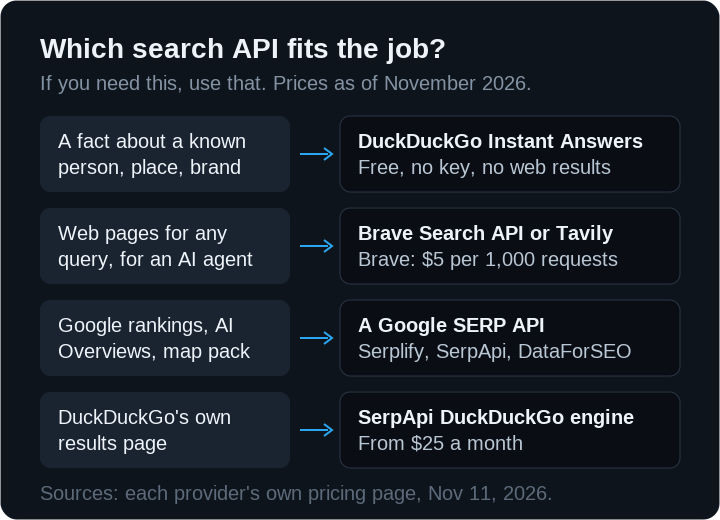
A fair read of the options:
- Brave is the closest thing to a DuckDuckGo search API. It runs its own index, costs $5 per 1,000 requests and gives $5 of credit a month. For general web results or an AI agent, it is often a better pick than a Google API, ours included. Our Brave Search API pricing guide covers its plans and key setup.
- Tavily suits agents that want short answers with sources. Its free tier needs no card.
- Serplify, which publishes this blog, returns Google’s results page as JSON. One SERP costs $0.005 and holds up to 100 results, with AI Overviews, People Also Ask and the local pack parsed. Failed searches cost nothing. It does not cover DuckDuckGo. Our Google SERP API page shows full Google results as JSON.
- SerpApi is the only option here that returns DuckDuckGo’s own results page, through its DuckDuckGo engine. It costs more per search than the others, and it counts only successful searches. Our list of SerpApi alternatives compares more Google APIs. One of them, DataForSEO, starts at $0.0006 per Google SERP.
Which one should you choose?
Use the DuckDuckGo Instant Answer API when you want a free, short summary of a known thing, such as a company, a place or a concept. Check that the reply matches the query before you show it, and credit DuckDuckGo and Wikipedia.
For anything that looks like a page of search results, it is the wrong tool. Pick Brave or Tavily for general web results. Pick a Google SERP API when the question is what Google shows. If you are giving an AI agent a search tool, our Google search MCP server guide builds one in about 75 lines of Python.
Frequently asked questions
Is the DuckDuckGo API free?
Yes. The Instant Answer API at api.duckduckgo.com is free and needs no key or account. DuckDuckGo's old API page asked for attribution, a t parameter with your app's name, and email approval for commercial use.
Do I need a DuckDuckGo API key?
No. DuckDuckGo has no API key system. You send a plain GET request with your query and format=json. DuckDuckGo asked developers to add a t parameter that names their app instead.
Does DuckDuckGo have an API for full search results?
No official one. DuckDuckGo said its API is for some instant answers, not full search results, and that it lacks the rights to syndicate its results. Most of its regular links come from Bing. Paid tools such as SerpApi's DuckDuckGo engine read DuckDuckGo's results page for you.
Why does the DuckDuckGo API return empty results?
Because it only answers known topics, such as a person, place, brand or concept. In our November 11, 2026 test, 282 of 301 real keywords (94%) came back empty. Try the bare topic name and check its capital letters. If Type is D, the reply is a list of possible meanings.
Is it OK to use the ddgs or duckduckgo_search library?
It is an unofficial library that reads DuckDuckGo's HTML results page, not an API. Its own page says it is for educational purposes only. Expect rate limit errors at volume, and read DuckDuckGo's terms, which ban reselling its services.
What is the best free alternative to the DuckDuckGo API?
For general web results, Brave gives $5 of credit a month, about 1,000 searches, and Tavily gives 1,000 credits a month with no card. For Google results, SerpApi has 250 free searches a month and Serplify gives $1 of credit at signup, about 200 SERPs. Checked November 11, 2026.
Sources and further reading
- DuckDuckGo Instant Answer API page, as archived on September 1, 2022 (summary, return fields, rules, limits) web.archive.org
- DuckDuckGo Help: Where do DuckDuckGo search results come from? duckduckgo.com
- DuckDuckGo Help: Does DuckDuckGo Search have Instant Answers? duckduckgo.com
- DuckDuckGo Help: How to use URL parameters to change your search settings duckduckgo.com
- DuckDuckGo Terms of Service duckduckgo.com
- DuckDuckGo Acceptable Use Policy duckduckgo.com
- PyPI: duckduckgo-search (renamed to ddgs) pypi.org
- PyPI: ddgs (Dux Distributed Global Search) pypi.org
- GitHub: ddgs DuckDuckGo engine source (html.duckduckgo.com) github.com
- GitHub: ddgs backend selection source (backend=auto) github.com
- GitHub: LangChain Community DuckDuckGo search wrapper source github.com
- Brave Search API: plans and pricing brave.com
- Tavily docs: API credits docs.tavily.com
- SerpApi: DuckDuckGo Search API serpapi.com
- SerpApi pricing serpapi.com
- DataForSEO: SERP API pricing dataforseo.com
- Google for Developers: Custom Search JSON API overview (closed to new customers) developers.google.com
- Microsoft Learn: Bing Search APIs retiring on August 11, 2025 learn.microsoft.com